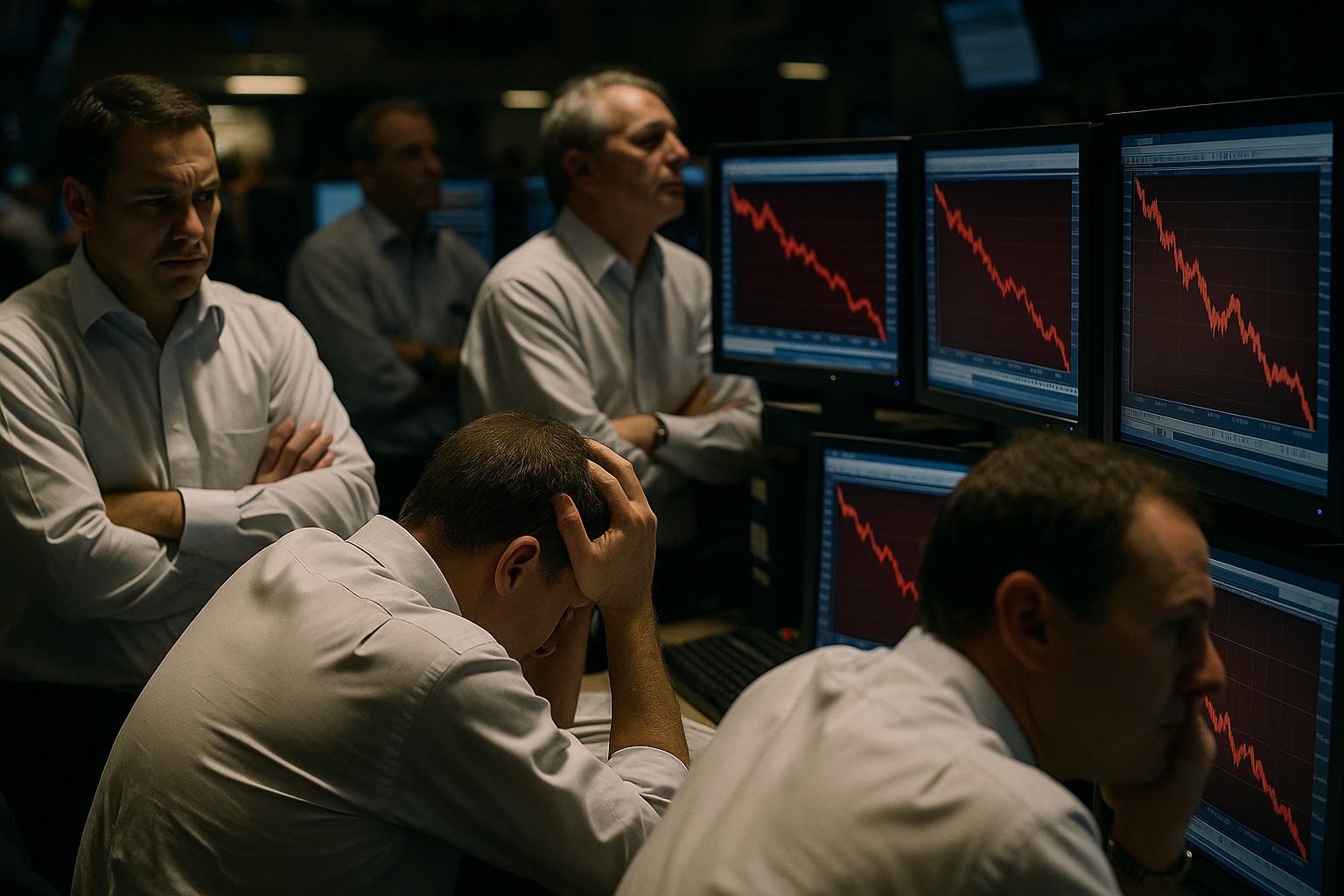
 AI-generated
What Actually Caused the 2008 Financial Crisis
Bank regulation is back in political debate. Understanding what broke in 2008 — and what regulators still disagree about — explains what's actually at stake.
What happened
Through the early-to-mid 2000s, US home prices rose sharply, driven in part by a boom in subprime mortgage lending — loans issued to borrowers with weaker credit, often with low initial "teaser" rates that reset higher after a few years.
Wall Street banks bundled these mortgages into mortgage-backed securities (MBS) and more complex instruments called collateralized debt obligations (CDOs), which were then sold to investors worldwide. Credit rating agencies rated large portions of these securities AAA — their highest safety grade — despite the underlying loans being far riskier than that rating implied.
In 1999, Congress passed the Gramm-Leach-Bliley Act, which repealed provisions of the 1933 Glass-Steagall Act that had separated commercial banking from investment banking. This is frequently cited as a factor that let banks take on the scale of mortgage-related risk they did, though economists dispute how much weight to give it (see "What's disputed" below).
When home prices stopped rising and began falling in 2006–2007, defaults on subprime mortgages surged. The securities built on those mortgages lost much of their value. Bear Stearns, a major investment bank, collapsed and was sold to JPMorgan Chase in a Fed-backed deal in March 2008.
The crisis peaked in September 2008: Lehman Brothers, a 158-year-old investment bank, filed for bankruptcy on September 15 after the government declined to bail it out. The insurance giant AIG, which had sold enormous volumes of credit default swaps insuring MBS, was bailed out by the Federal Reserve within days. Credit markets froze globally.
Congress passed the Troubled Asset Relief Program (TARP) in October 2008, authorizing up to $700 billion to stabilize banks. The recession that followed — the Great Recession — lasted from December 2007 to June 2009 by the National Bureau of Economic Research's dating, and unemployment in the US peaked at 10% in October 2009, according to the Bureau of Labor Statistics.
What official investigators concluded
The Financial Crisis Inquiry Commission (FCIC), a bipartisan panel created by Congress, published its final report in January 2011 after a lengthy investigation. Its majority conclusion was that the crisis was avoidable and resulted from 'widespread failures in financial regulation,' 'dramatic breakdowns in corporate governance,' excessive borrowing and risk-taking by households and Wall Street, and policymakers who were 'ill prepared for the crisis.'
The report placed significant weight on the private-label securitization market — banks packaging and selling mortgage securities with insufficient regard for underlying loan quality — and on regulators' failure to rein in high-risk lending practices that were visible well before 2007.
What's disputed
Not every FCIC commissioner agreed with the majority finding. Three Republican-appointed commissioners, including Peter Wallison, issued a dissent arguing that US government housing policy — particularly the role of government-sponsored enterprises Fannie Mae and Freddie Mac in expanding affordable-housing lending targets — was a primary driver of the crisis, not merely a contributing factor.
Economists remain divided on how much weight to assign to different causes: private-sector subprime lending and securitization, the Fannie Mae/Freddie Mac role, the Gramm-Leach-Bliley repeal of Glass-Steagall provisions, credit rating agency incentives, the Federal Reserve's monetary policy in the early 2000s, and global capital flows that pushed money into US mortgage markets. This is an active area of academic debate, not a settled consensus, and it shapes ongoing political arguments about how much bank regulation is warranted today.
What we know
- Subprime mortgage defaults, triggered by falling home prices, set off the crisis.
- Mortgage-backed securities built on those loans were rated far safer than they turned out to be.
- Lehman Brothers' September 2008 bankruptcy and AIG's bailout marked the acute phase of the crisis.
- The FCIC's official, bipartisan-commissioned investigation concluded the crisis was avoidable and driven primarily by regulatory and private-sector failures.
What's disputed
- How much responsibility belongs to government housing policy (Fannie Mae/Freddie Mac) versus private-sector lending and securitization.
- How much the 1999 partial repeal of Glass-Steagall actually contributed, versus other regulatory gaps.
- The right level of bank regulation today, which is directly downstream of which causal account you find more persuasive.
What it means
- Current debates over rolling back or tightening bank capital and oversight rules are, in substance, a continuation of this unresolved argument about what caused 2008 — not a new disagreement.