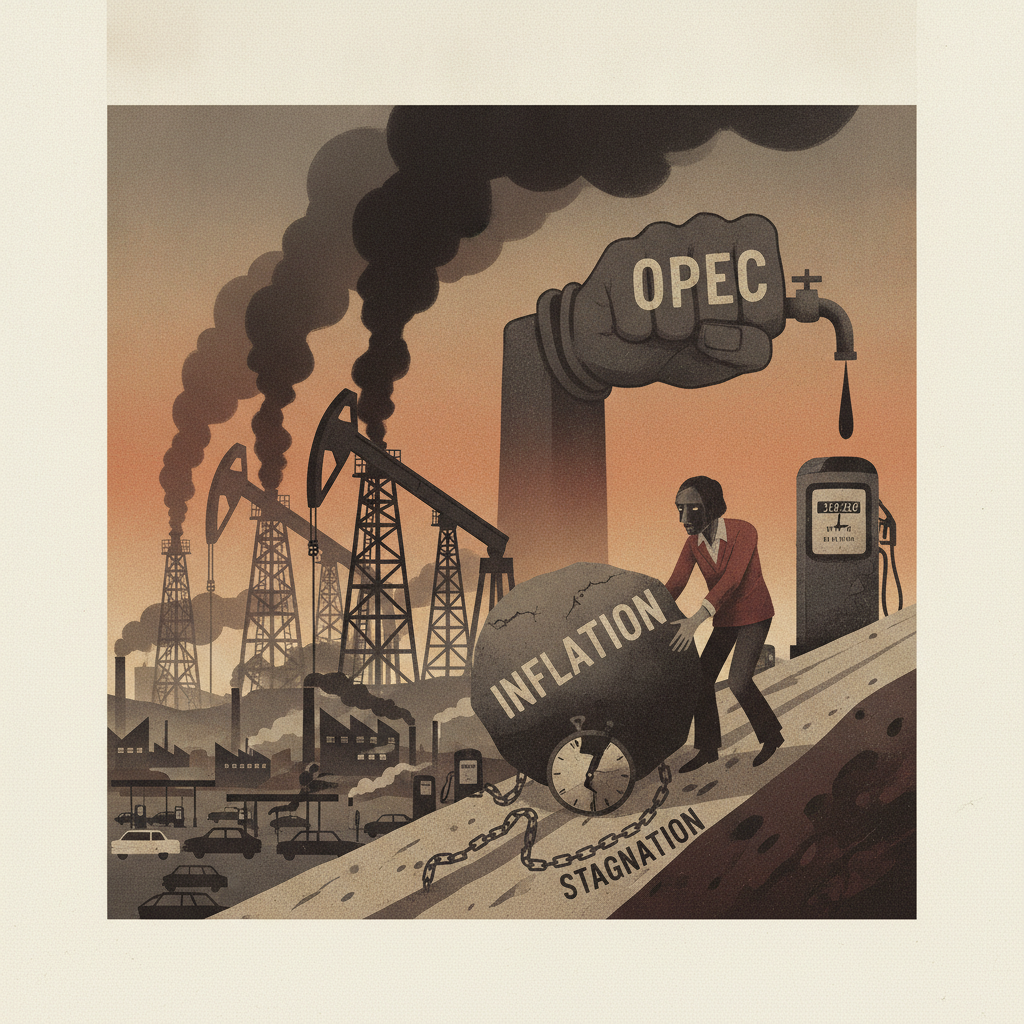
 AI-generated
The 1970s Oil Shocks and the Emergence of Stagflation in the United States
The combination of sharp energy price increases and simultaneous high inflation with unemployment in the 1970s continues to shape debates over how central banks should respond to supply disruptions.
What happened
In October 1973, following the Yom Kippur War, the Organization of Arab Petroleum Exporting Countries imposed an embargo on oil exports to the United States and several other nations. This action, combined with production cuts by OPEC members, caused the posted price of Saudi crude to rise from approximately three dollars per barrel in early 1973 to nearly twelve dollars by the end of 1974.
The United States entered a recession in November 1973 that lasted until March 1975. During this period the consumer price index rose at double-digit annual rates while unemployment reached 8.9 percent in May 1975. A second disruption began in late 1978 after strikes and political upheaval in Iran curtailed that country's oil exports, pushing prices above thirty dollars per barrel by mid-1980.
Both episodes produced the unusual combination of rising prices and falling output that came to be called stagflation. Real GDP contracted in 1974 and again in 1980, while inflation remained above 9 percent for most of the decade.
Immediate policy responses
The Nixon administration imposed wage and price controls in August 1971 that remained in place through much of the first oil shock. These controls were lifted in stages between 1973 and 1974, after which measured inflation accelerated.
The Federal Reserve under Chairman Arthur Burns pursued accommodative policy for much of the 1970s, allowing rapid growth in the money supply. In October 1979, newly appointed Chairman Paul Volcker announced a shift to targeting non-borrowed reserves, which produced short-term interest rates above 20 percent and a sharp recession in 1981-82.
Conclusions of official and academic investigations
The 1975 Economic Report of the President attributed the inflation surge primarily to the oil price increase and to food shortages, while acknowledging that prior monetary expansion had left the economy vulnerable. Later analyses by the Federal Reserve Board staff emphasized that the oil shocks alone could not account for the persistence of inflation through the late 1970s.
Economists associated with the National Bureau of Economic Research, including Robert J. Gordon, documented that the 1970s inflation was the largest peacetime episode in U.S. history and coincided with a breakdown in the Phillips curve relationship between unemployment and wage growth.
Longer-term economic consequences
The two oil shocks contributed to a decline in U.S. manufacturing productivity growth that lasted into the 1980s. They also prompted conservation measures, the creation of the Strategic Petroleum Reserve in 1975, and gradual deregulation of domestic oil prices completed in 1981.
By the mid-1980s, inflation had fallen below 4 percent and unemployment had returned to levels near 5 percent, ending the stagflation period but leaving a legacy of heightened sensitivity to energy prices in macroeconomic models.
What we know
- Crude oil prices rose from roughly $3 to $12 per barrel between 1973 and 1974 and exceeded $30 per barrel after the 1979 Iranian disruption.
- The United States recorded simultaneous double-digit inflation and unemployment rates above 8 percent in both 1974-75 and 1979-80.
- The Federal Reserve shifted to a reserves-based operating procedure in October 1979 under Paul Volcker.
- Real GDP contracted in 1974 and again in 1980.
What's disputed
- Milton Friedman and other monetarists maintained that excessively expansionary monetary policy was the dominant cause of the decade's inflation, while supply-shock explanations advanced by James Tobin and others assigned primary weight to the oil price increases themselves.
- Some later studies, including work by Robert Barsky and Lutz Kilian, argue that monetary accommodation amplified the effects of the oil shocks, whereas others contend that the shocks would have produced stagflation even under tighter policy.
What it means
- The episode demonstrated that large adverse supply shocks can produce simultaneous rises in unemployment and inflation, complicating the use of conventional Phillips-curve policy rules.
- It contributed to the subsequent emphasis on central-bank credibility and inflation targeting that shaped policy frameworks after 1980.