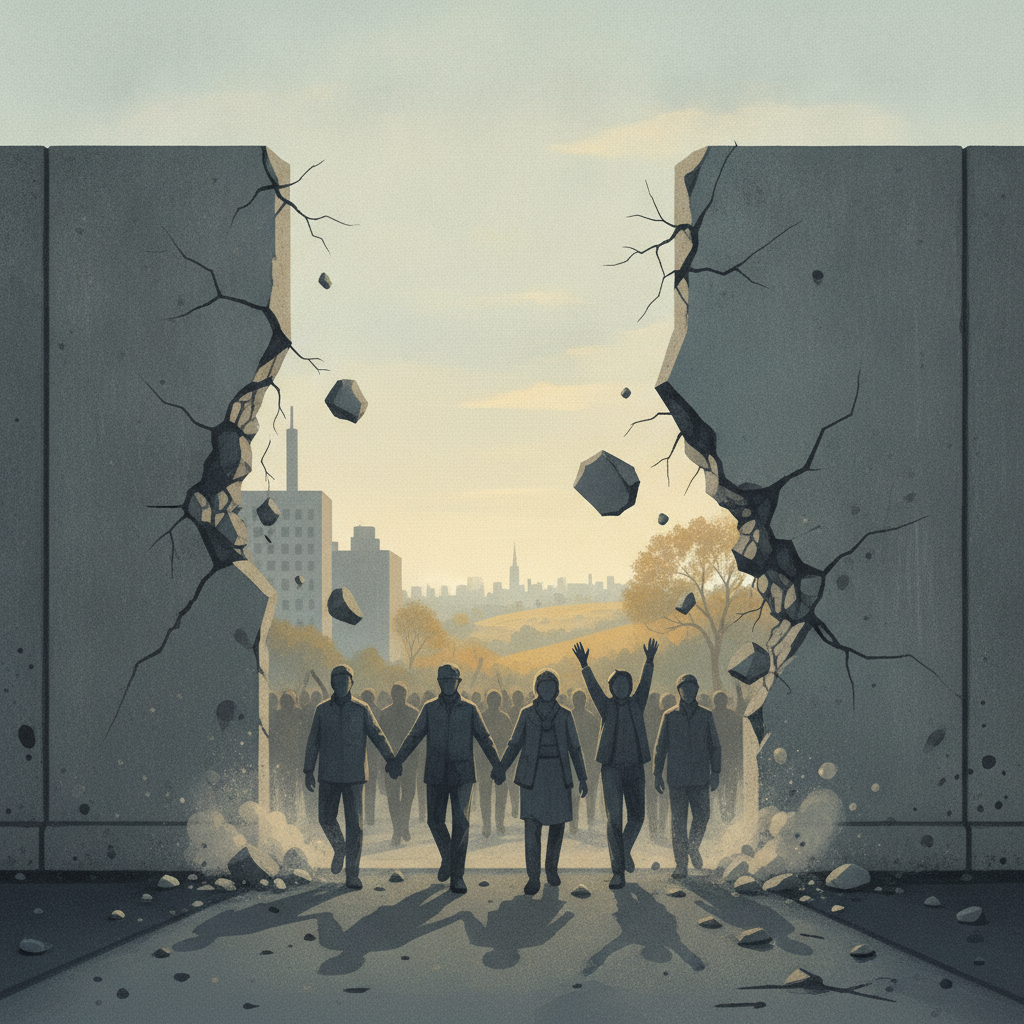
 AI-generated
The Fall of the Berlin Wall on November 9, 1989, and the Dissolution of the Soviet Union
The rapid sequence of events from 1989 to 1991 shows how internal reforms and popular protests ended four decades of European division, providing context for understanding today's relations between Russia, the United States, and the European Union.
What happened
On November 9, 1989, the East German government announced that its citizens could cross into West Berlin, leading crowds to gather at the Berlin Wall and begin dismantling sections of the barrier that night.
The announcement followed weeks of large demonstrations in East German cities and the opening of the Hungarian border with Austria in September 1989, which allowed thousands of East Germans to emigrate westward.
German reunification occurred on October 3, 1990, after the March 1990 elections in East Germany produced a government that negotiated the terms with West Germany and the four occupying powers.
The Soviet Union formally dissolved on December 25, 1991, when President Mikhail Gorbachev resigned and the republics declared independence, ending the state that had anchored the Warsaw Pact since 1955.
Soviet policy changes under Gorbachev
Mikhail Gorbachev became General Secretary of the Communist Party of the Soviet Union in March 1985 and introduced the policies of glasnost and perestroika, which reduced censorship and attempted economic restructuring.
In 1988 Gorbachev announced a reduction of Soviet forces in Eastern Europe and stated that the Brezhnev Doctrine no longer applied, signaling that the USSR would not intervene militarily to preserve allied regimes.
These decisions removed the external guarantee that had kept the East German leadership in power since the construction of the Berlin Wall in August 1961.
Eastern European transitions in 1989
Poland held partially free elections in June 1989 that resulted in a non-communist government, followed by the opening of the Hungarian-Austrian border in September.
Mass protests in East Germany, Czechoslovakia, and Bulgaria produced leadership changes without Soviet military intervention, unlike the interventions of 1956 and 1968.
The cumulative effect of these transitions eliminated the Warsaw Pact as a functioning military alliance by early 1990.
Assessments by historians and official records
John Lewis Gaddis, in his 2005 book The Cold War: A New History, attributes the outcome primarily to the internal contradictions of the Soviet system and Gorbachev's unwillingness to use force.
The National Security Archive at George Washington University has published declassified U.S. and Soviet documents showing that Western governments anticipated instability but did not plan the specific sequence of 1989 events.
Historians continue to debate the relative weight of economic stagnation, nationalist movements within the USSR, and external diplomatic pressure in producing the final result.
What we know
- The Berlin Wall was opened to traffic on November 9, 1989, after an East German Politburo decision.
- The Soviet Union dissolved on December 25, 1991, following declarations of independence by its constituent republics.
- No Soviet military intervention occurred in Eastern Europe in 1989, in contrast to 1956 and 1968.
- German reunification was completed on October 3, 1990, under the terms of the Treaty on the Final Settlement with Respect to Germany.
What's disputed
- Gaddis emphasizes Gorbachev's personal choices and Soviet structural weaknesses, while some Russian historians stress the cumulative effect of Western economic and military competition.
- Scholars differ on whether the Malta Summit of December 1989 between Gorbachev and George H. W. Bush marked the effective end of the Cold War or whether that designation belongs to the 1991 dissolution of the USSR.
What it means
- The 1989-1991 period is frequently cited in discussions of how rapid regime change can occur when external security guarantees are withdrawn.
- Contemporary debates over NATO enlargement and Russian security concerns often reference the diplomatic understandings and misunderstandings of 1989-1990.